

Adularia
A Gemstone Study: Moonstone

Most gemstones speak in an outward language. Their beauty is often assessed through brilliance, clarity, and colour. It’s a visual language we have learned to respond to instinctively.
Moonstone requires a different way of looking.
It must be tilted and turned. Its light glows beneath the surface, surfacing gently and retreating again. No single angle offers a complete view, and its appearance is never fixed.
This study is intended as a deep inquiry into the gemstone. You can read about Naiad’s moonstones here:
Phenomena and Science
Moonstones belong to the feldspar group, one of the most widespread minerals on earth. Within the same group also includes gemstones like sunstones and labradorites.
What makes moonstone — orthoclase feldspar — unique, is its phenomenon.
A Study in Adularescence
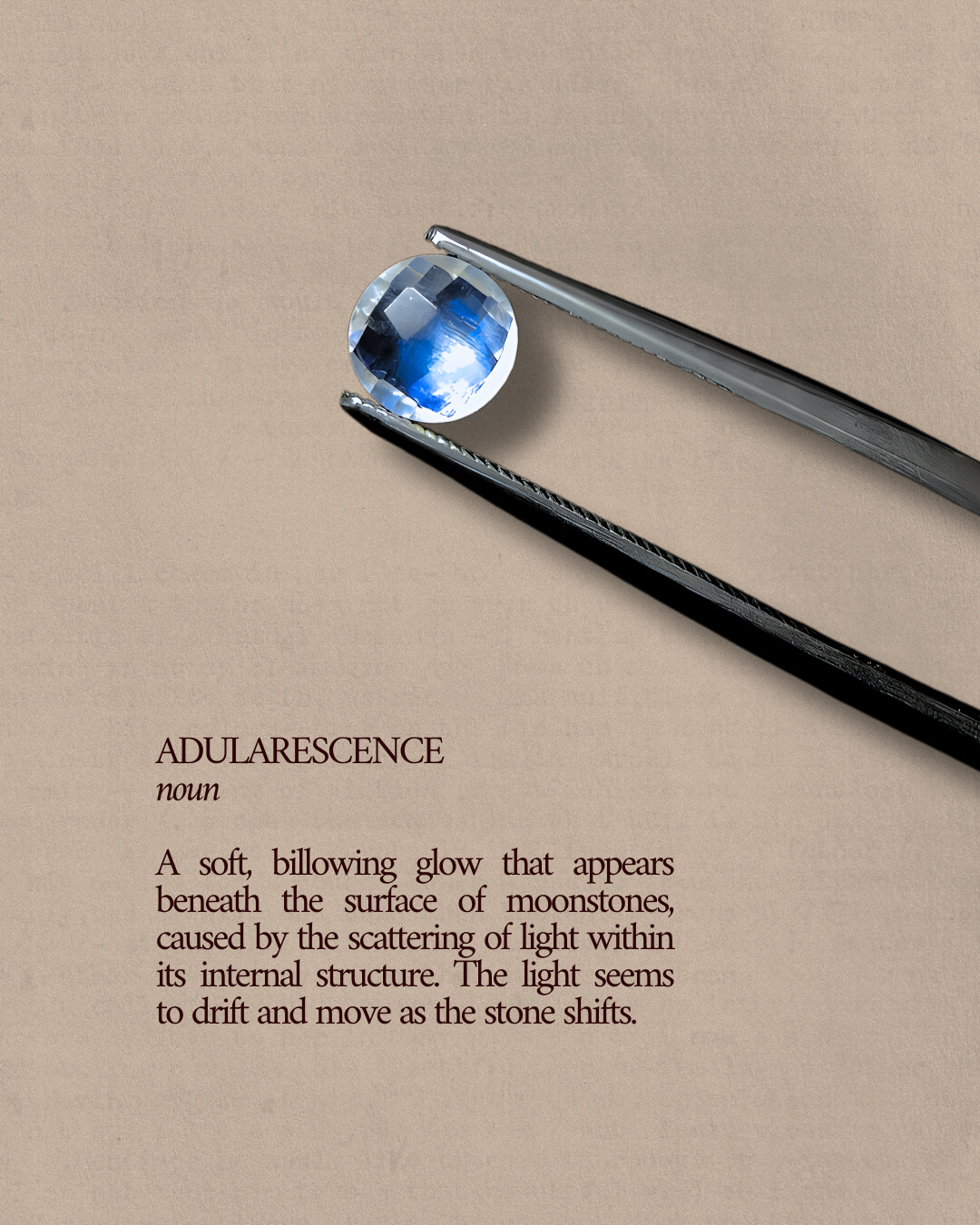
Perhaps the most captivating aspect of this gemstone is the motion — the misty light that rolls across it’s surface.
Adularescence is an optical phenomenon created by the moonstone’s internal structure. During formation, two feldspar species — orthoclase and albite — grow interwoven within the stone. As the molten material cools and begins to crystallise, these species arrange themselves into fine, alternating layers. Light entering the stone is scattered between them, producing the soft, rolling glow that appears to move just beneath the surface.
Adularia
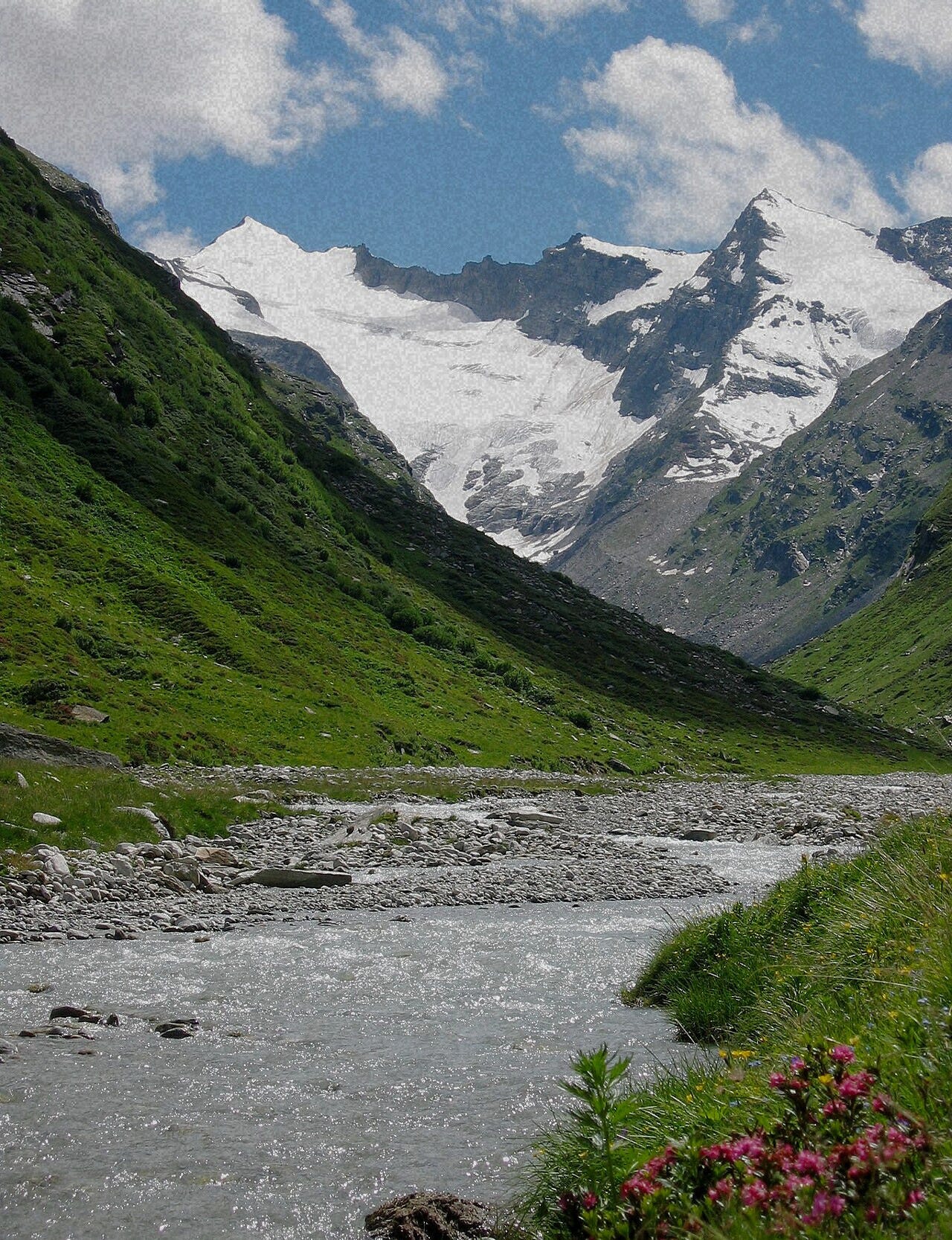
The name Adularia predates modern gem classification. It refers to a specific, high quality form of orthoclase feldspar once sourced from Mount Adula in the Swiss Alps. These stones were among the earliest moonstones recognised as fine quality — characterised by a near colourless, semi transparent body and a clearly defined blue adularescence.
This vivid blue adularescence, revealed only in the finest specimens, is known in the trade as blue sheen.
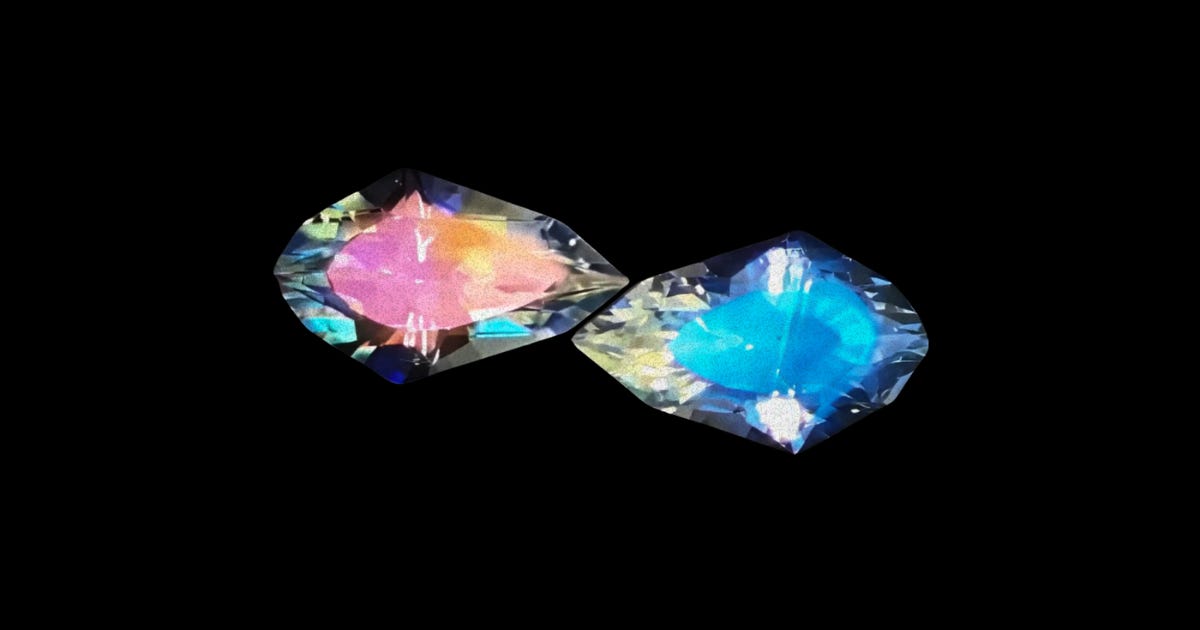
A multicoloured form of adularescence is also observed in so-called rainbow moonstone, a variety of labradorite feldspar. The finest examples, discovered only recently in Madagascar in 2023, display a distinct orange flash alongside the characteristic blue. In rare cases, additional colours emerge — from soft pinks to shades of green and turquoise — creating an exceptional display of iridescent lightplay.
Cutting
Moonstone exhibits two distinct cleavage planes — the crystal naturally separates along two directions at right angles to each other. These planes must be carefully considered during cutting, as they directly affect both durability and visibility of adularescence.
For moonstone, symmetry alone is not the primary consideration. Correct orientation is essential as the phenomenon only appears when the stone is cut in alignment with its internal structure. Even minor deviations in angle can weaken or disrupt the way light travels within the stone.
With commercial grade rough, cutters may value yield over optical performance. With fine quality rough, however, precision is everything. Cutters may sacrifice material in order to achieve the correct orientation, thereby maximising adularescence. A smaller moonstone with a vivid sheen will always be more valuable than a larger stone that performs poorly.
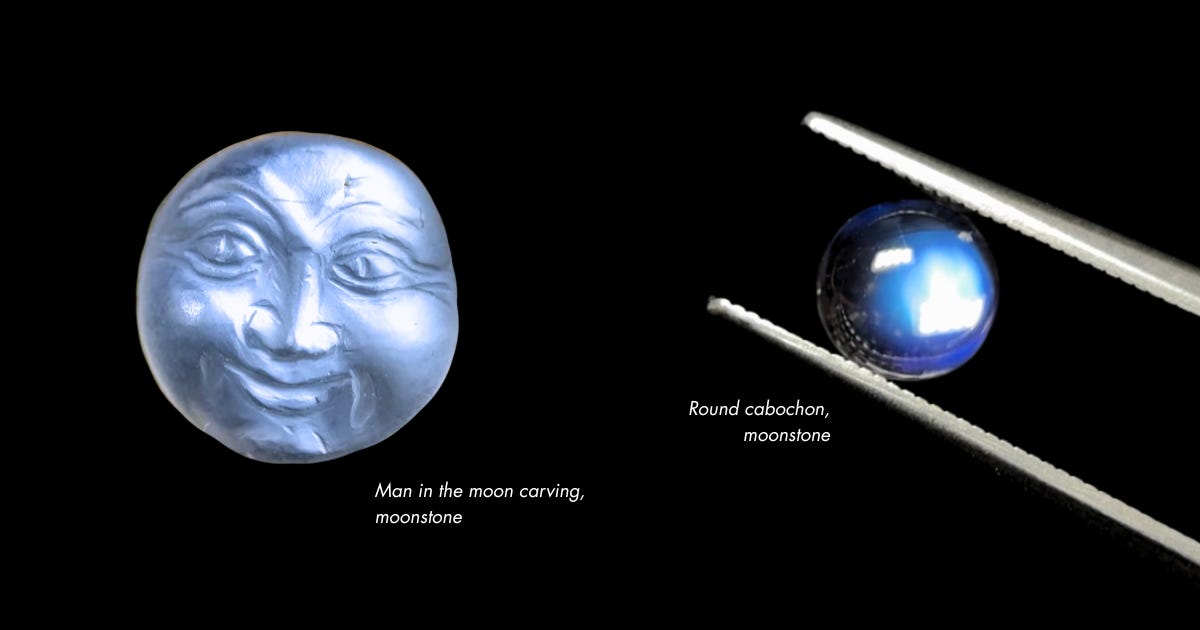
Cabochons remain the most widely used cut for moonstone. The curved surface allows the adularescence to roll over smoothly across the stone. Historically, moonstones were also carved with symbolic motifs. During the Art Nouveau period, carvings such as the man in the moon became popular.
In recent years, faceted moonstones have gained popularity. This approach requires a high degree of mastery, as excessive faceting or incorrect proportions can disrupt how light travels within the stone.
Within the La Luna Collection, we worked closely with our stone cutter to transform moonstones into custom cut modified pear shapes. Proportions were carefully considered to not only maximise light performance, but visual appearance as well. The result is a cut that feels modernly talismanic.
A Historical Take
In ancient Rome, moonstones were associated with lunar imagery and believed to embody moonlight. In India, it was a sacred stone, valued for protective qualities and symbolic connection to intuition and continuity.
The stone re-entered prominence at the turn of the twentieth century through the Art Nouveau movement — a period that favoured organic form and symbolic material. Moonstone’s subdued glow and appearance aligned with this aesthetic, and was frequently used by designers such as René Lalique, and Louis C. Tiffany.
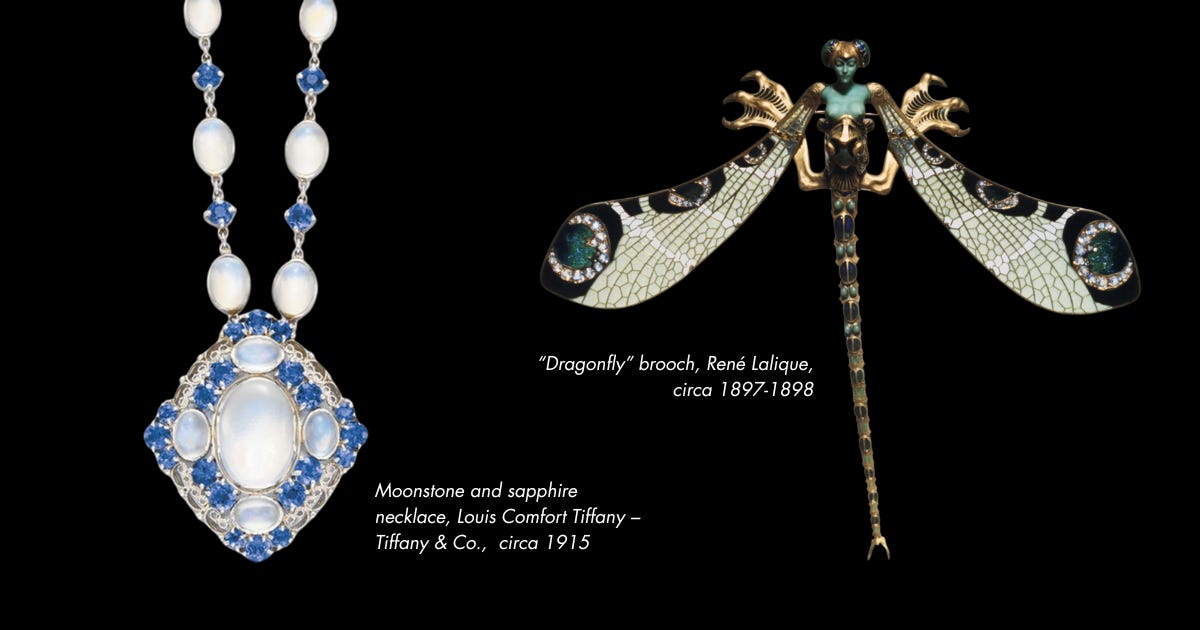
By the 1920s, the rise of Art Deco shifted aesthetic preference toward bolder, more geometric design. Stones with strong contrast, precision, and visual impact came to define the period, and moonstone fell out of favour.
Interest in moonstone resurfaced in the 1990s, alongside a renewed focus on material nuance and personal symbolism in jewelry. While moonstones have never been among the most widely recognised gemstones, it continues to attract collectors and designers who value restraint, texture, and behaviour over display.
Moonstone exists largely outside of broad trend cycles. Its value lies in personal resonance, and for those drawn to it, its appeal is lasting.
Glossary
Orthoclase feldspar
The scientific name of moonstone, a potassium rich feldspar mineral.
Adularescence
A soft, billowing glow that appears beneath the surface of moonstones, caused by the scattering of light within its internal structure. The light seems to drift and move as the stone shifts
Blue sheen
A trade term used to describe vivid blue adularescence displayed by the finest moonstone.
Labradorite feldspar
The scientific name for what is commonly referred to as rainbow moonstone. Rainbow moonstones are a variety of labradorite, not orthoclase.
Cabochon
A gemstone cut with a smooth, rounded surface and no facets.
Art Nouveau
An artistic movement active at the turn of the twentieth century, characterised by organic forms, fluid lines, and symbolic material use. Moonstone featured prominently due to its atmospheric and internal light qualities.
René Lalique
Renowned as both a jeweller and master glassmaker. His work was central to the development of Art Nouveau and influential in the early evolution of Art Deco.
Louis C. Tiffany
Best known for his stained glass lamps and windows. Appointed Tiffany & Co.’s first design director, he was a leading figure in the Art Nouveau movement and applied its principles to jewelry design.
Art Deco
A design movement emerging in the 1920s, defined by geometric form, symmetry, and visual impact. Favoured gemstones with strong contrast and precision, contributing to moonstone’s decline in popularity during this period.
Before you go, you’re welcome to linger a little longer.
We are most active on Instagram, go check us out!
Enter the world of Naiad, where jewelry is our medium!
If something here resonated with you, please tell us — we’d love to hear your thoughts!
Stay with us a little longer…
In 2026, we commit to practice over pace.
To growing with intention, slowly and in alignment.